
Unemployment Rises Again in August 2026
Unemployment in Germany increased again in August 2026. Given the ongoing difficult geopolitical and economic situation, the German labour market remains under pressure despite a slight economic recovery.
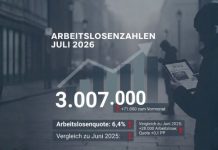
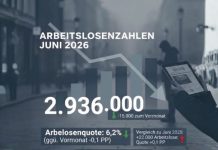
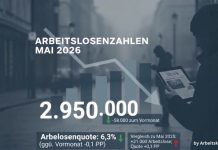
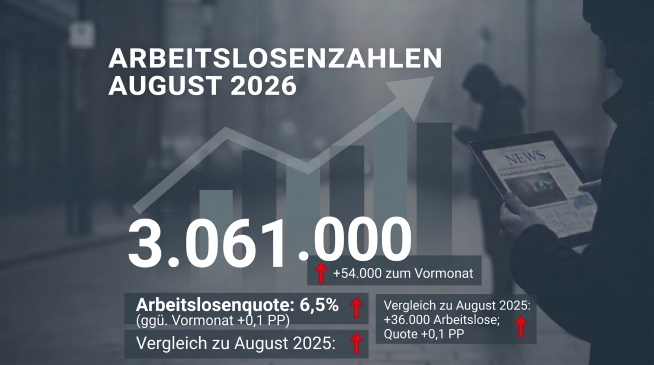
A total of 3,061,000 people were unemployed, an increase of 54,000 compared with the previous month. After seasonal adjustment, the number of unemployed people was 4,000 higher than in July. The unemployment rate rose slightly by 0.1 percentage points to 6.5 percent. Compared with August 2025, the number of unemployed people increased by 36,000, while the unemployment rate also rose by 0.1 percentage points.
Underemployment and ILO Unemployment Rate
Underemployment, which includes not only registered unemployment but also short-term incapacity for work and participation in labour market policy programmes, decreased slightly in August after seasonal adjustment. At 3,674,000 people, however, it was still 33,000 higher than one year earlier.
The unemployment rate based on the International Labour Organization (ILO) employment concept stood at 4.2 percent in July 2026. This figure provides a somewhat different picture because it is based on different definitions and is designed to allow international comparisons.
Short-Time Work
In August, companies submitted notifications of short-time work for 14,000 employees due to economic reasons. Current data on the actual use of short-time work benefits is available up to June 2026. At that time, 140,000 people received short-time work benefits, 8,000 more than in the previous month but around 55,000 fewer than in June 2025.
Employment Trends
The number of employed people in Germany fell by a seasonally adjusted 14,000 in July 2026 to 45.66 million. Compared with the previous year, this represents a decrease of 226,000 people.
Employment subject to social security contributions increased slightly by 1,000 people in June to 34.81 million, but was 73,000 lower than one year earlier. The number of people in marginal employment, including so-called mini-jobs, also declined to 7.62 million, with a particularly noticeable decrease in secondary jobs.
Demand for Workers Remains Weak
Demand for workers remains subdued. In August, 656,000 job vacancies were registered with the Federal Employment Agency (Bundesagentur für Arbeit), 25,000 more than in the same month of the previous year.
The BA Job Index (BA-X), which measures demand for workers, remained stable at 103 points and was four points higher than one year earlier.
Training and Continuing Education
Germany is currently reforming its employment support system and investing more heavily in professional qualifications and continuing education. To successfully manage the ongoing transformation of the labour market, further training in future-oriented fields such as AI Management or AI Automation can be particularly valuable. Eligible training programmes may be funded through Germany’s education voucher (Bildungsgutschein).
Unemployment Benefits and Basic Income Support
In August 2026, 1,133,000 people received unemployment benefit (Arbeitslosengeld), an increase of 109,000 compared with the previous year.
At the same time, the number of employable people receiving basic income support fell to 3,754,000, a decrease of 116,000. This corresponds to 6.9 percent of Germany’s working-age population being dependent on basic income support.
Vocational Training Market Remains Challenging
Since October 2025, 433,000 applicants have registered with employment agencies in search of a vocational training position (Ausbildungsplatz), 4,000 more than in the previous year.
By August, 156,000 applicants had started vocational training, 11,000 fewer than during the same period of the previous year. At the same time, 102,000 applicants were still looking for a training position.
Employers reported a total of 451,000 vocational training positions, of which 116,000 were still vacant. The vocational training market will remain active until the end of September, meaning that the number of unfilled positions and applicants without a training place is expected to decrease further.
Despite a slight economic recovery, the German labour market remained under pressure in August 2026. Unemployment and underemployment have increased, overall employment has declined, and demand for workers remains weak. The vocational training market, in particular, continues to face significant challenges.
In June, 6.02 million foreign nationals were employed in Germany in jobs subject to social security contributions. Their number increased by 184,000 compared with the previous year. This increase was entirely driven by people from so-called third countries, meaning countries outside the European Union. This included an increase of 64,000 employees from Ukraine, 51,000 from major countries of origin of asylum seekers, and 17,000 from Western Balkan countries.
Source: Federal Employment Agency (Bundesagentur für Arbeit), Labour Market in August 2026