
Slight Easing in the German Labor Market in September
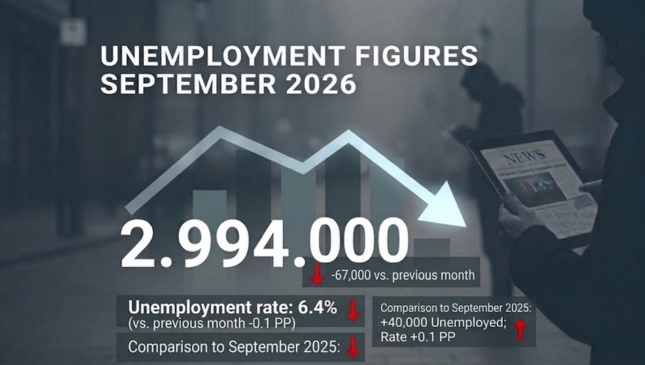
In September 2026, the German labor market showed initial signs of an autumn upturn, though it remains rather subdued. The number of unemployed individuals fell by 67,000 to just under 2,994,000, corresponding to an unemployment rate of 6.4 percent. Despite this decline, unemployment remains 40,000 higher than at the same time last year. On a seasonally adjusted basis, unemployment even edged up slightly by 12,000, signaling that a full economic recovery has yet to materialize.
Underemployment and ILO Unemployment
Underemployment—which accounts for registered unemployment as well as short-term incapacity to work and active labor market policy measures—decreased by a seasonally adjusted 7,000 people to 3.615 million. Compared to the previous year, however, underemployment is up by 25,000. The unemployment rate according to the ILO concept stood at 4.3 percent in August, offering complementary insight alongside the official national unemployment figures.
Trends in Short-Time Work (Kurzarbeit)
Notifications for cyclical short-time work remained relatively low in September at 18,000 individuals. According to preliminary data, actual claims for short-time work benefits stood at 118,000 employees in July. This represents a drop of 13,000 compared to the previous month and a notable reduction of 69,000 year-on-year. However, the overall level remains slightly elevated over the long term.
Employment and Workforce Levels
The total number of employed persons fell by a seasonally adjusted 29,000 to 45.58 million in August, which is 236,000 below the prior-year level. Employment subject to social security contributions also contracted slightly by 12,000 between June and July; at 34.68 million employees, it sits 84,000 below last year’s figure. Marginal employment (mini-jobs) decreased by 50,000 year-on-year to 7.61 million workers.
Labor Demand Remains Subdued
Demand for new staff continues to be muted. In September, 660,000 job vacancies were registered with the Federal Employment Agency (BA), up by 30,000 compared to a year ago. The BA Job Index (BA-X) ticked up by one point to 104, placing it six points higher year-on-year and indicating a moderate improvement in labor demand.
Social Benefits and Welfare Support
Approximately 1.08 million people received unemployment benefits (Arbeitslosengeld) in September—an increase of 85,000 compared to last year. Conversely, the number of employable individuals eligible for basic income support fell by 145,000 to 3.7 million. As a result, 6.8 percent of the working-age population required support, underscoring ongoing challenges in the social sector.
Despite the seasonal autumn pickup, Germany’s labor market in September 2026 remains overall subdued. To navigate the structural transformation successfully, targeted upskilling—such as qualifications for AI Managers or specialized training in AI automation—is highly relevant and eligible for funding through the German education voucher (Bildungsgutschein). While registered unemployment saw a slight dip, overall employment and jobs subject to social security contributions declined. Labor demand shows only moderate signs of recovery, while the need for welfare support remains persistently high.
Source: Federal Employment Agency (Bundesagentur für Arbeit), Labor Market Report September 2026