
Unemployment Figures and Rate Stable, but Still at a High Level
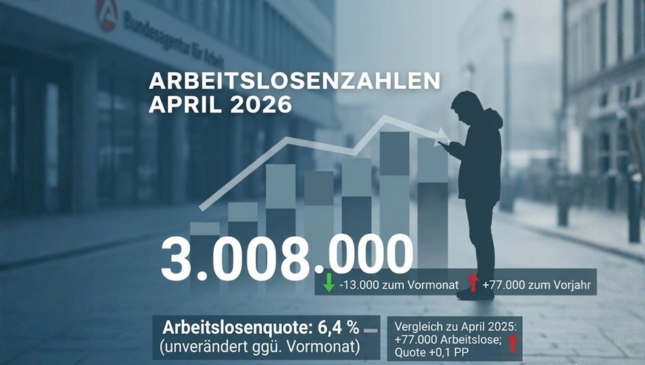
The Federal Employment Agency (Bundesagentur für Arbeit, BA) reported a slight decline in unemployment in April 2026. The number of unemployed people fell by 13,000 to 3.008 million. Despite this decrease, unemployment was still 77,000 higher than in the same month last year. The unemployment rate remained unchanged at 6.4 percent. Seasonally adjusted, the number of unemployed people even increased by 20,000 compared with the previous month. According to the ILO definition, the unemployment rate stood at 4.2 percent in March.
Underemployment and Short-Time Work
Underemployment, which includes unemployment as well as short-term incapacity for work and labour market policy measures, rose by 12,000 on a seasonally adjusted basis to 3.665 million. Compared with the previous year, underemployment was 18,000 higher.
In April, notifications for short-time work due to economic reasons were submitted for 28,000 people. The actual use of short-time work allowance stood at 156,000 employees in February. This was 11,000 more than in the previous month, but 114,000 fewer than one year earlier.
Employment and Labour Force Participation Declining
The number of people in employment fell by 25,000 on a seasonally adjusted basis in March to 45.66 million. Compared with the previous year, this represents a decline of 182,000 people.
Employment subject to social security contributions decreased by 16,000 from January to February. At 34.75 million employees, it was 96,000 below the previous year’s level.
Marginal employment declined by 51,000 to 7.47 million. Around half of these employees were exclusively in marginal employment.
Demand for Labour Remains Low
Demand for labour has stabilised at a low level. In April, 641,000 vacancies were registered with the BA, 5,000 fewer than one year earlier.
The BA Job Index (BA-X), which takes into account both the stock of reported vacancies and newly reported vacancies, fell slightly by one point to 102.
Cash Benefits and the Training Market
In April, around 1.07 million people received unemployment benefit, an increase of 93,000 compared with the previous year.
The number of employable citizens’ benefit recipients fell to 3.826 million, which was 125,000 fewer than in April 2025. As a result, 7.0 percent of the employable population were in need of assistance.
In the training market, a total of 357,000 applicants had registered since October 2025, representing a slight increase of 1 percent year-on-year. By April, 211,000 of them had not yet found a training position or an alternative.
The number of reported training positions stood at 380,000. However, due to changes in the statistics, this figure is currently underreported. Estimates suggest that the number of training positions in March 2026 was around 7 percent below the previous year’s level. Placement into training positions that are not statistically recorded is not affected by this. The training market remains dynamic in April, meaning that the current data only allows for a preliminary assessment.
Conclusion
The spring recovery in the German labour market remained subdued in April 2026. Despite seasonal effects, unemployment stayed at a high level, while employment and labour force participation declined slightly.
Demand for labour has stabilised at a low level, and the training market continues to face challenges despite slight increases in applicant numbers. Overall, the latest developments point to a persistently tense situation in the labour market.
Source: Federal Employment Agency, April 2026