
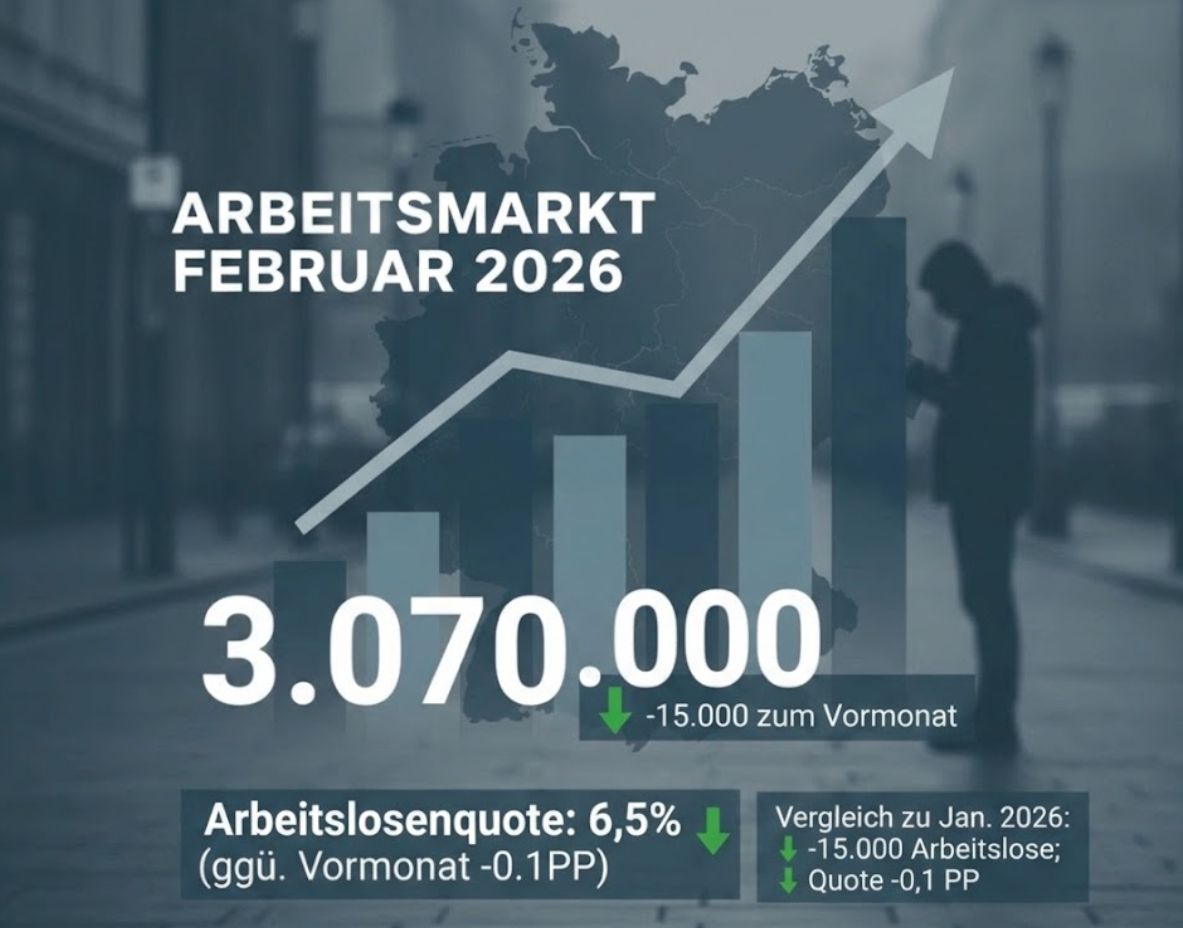

Even at the end of the winter lull, the German labor market remains without a noticeable upswing. In February 2026, the number of unemployed people fell by 15,000 to 3,070,000. Seasonally adjusted, however, this represents virtually no change compared with the previous month, as only an increase of 1,000 people was recorded. The unemployment rate declined slightly by 0.1 percentage points to 6.5 percent.
Compared with the same month last year, however, the number of unemployed rose by 81,000 people. The rate is therefore also 0.1 percentage points above the level recorded a year earlier. According to the ILO labor force concept of the Federal Statistical Office, the unemployment rate stood at 4.2 percent in January.
Underemployment
Underemployment, which in addition to registered unemployment also includes labor market policy measures as well as short-term incapacity to work, fell by 3,000 people on a seasonally adjusted basis. In total, it amounted to 3,724,000 and was thus slightly below the level of the previous year. This development suggests that the labor market is stabilizing, albeit at an overall subdued level.
Employment and Labor Force Slightly Declining
The number of employed persons fell in January 2026 by 13,000 on a seasonally adjusted basis to 45.66 million. Compared with the previous year, this represents a decrease of 94,000 people.
Social security–liable employment increased slightly by 5,000 people between November and December 2025. Overall, however, at 34.98 million it was 40,000 below the level recorded a year earlier.
A decline is also evident in the area of marginal employment. In December 2025, 7.58 million people were marginally employed, 46,000 fewer than a year earlier. Of these, 4.07 million were exclusively marginally employed, while 3.51 million held such employment as a secondary job.
Labor Demand Stabilizes at a Low Level
In February, 638,000 job vacancies were registered with the Federal Employment Agency. This corresponds to a slight decrease of 1,000 vacancies compared with the previous year.
The BA Job Index (BA-X) rose by 4 points to 106 points. This indicator takes into account not only the stock but also the inflow of newly reported vacancies. However, the development is influenced by individual large-scale reports from employers. A broad-based increase in demand for labor is not evident. Instead, demand is stabilizing at a low level.
Training Market with Mixed Signals
Since October 2025, 298,000 applicants have registered with employment agencies and job centers, 4,000 more than in the same period last year. At the same time, 345,000 vocational training positions were reported. This is 52,000 fewer than in the comparable period of the previous year.
As the training market is still highly dynamic in February, the current figures only allow for a preliminary assessment. A reliable evaluation will only be possible in the coming months.
Conclusion
The current data show a labor market that is stabilizing but without clear upward momentum. Unemployment remains above the three-million mark. Employment is developing sideways to slightly downward. Demand for labor remains at a low level. For companies, this continues to mean a challenging environment with cautious workforce planning. For employees, the situation remains differentiated, with strongly varying prospects depending on region and industry.