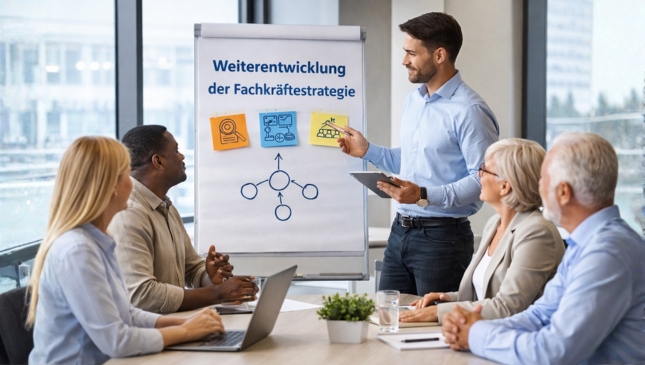

The German government is advancing the further development of its skilled labour strategy with a new dialogue format and a policy impulse paper. The starting point was the first Regional Skilled Labour Workshop, which took place on 12 March at the aircraft engine manufacturer Rolls-Royce in Dahlewitz.
Federal Minister of Labour and Social Affairs Bärbel Bas opened the event together with Brandenburg’s Minister-President Dietmar Woidke. The new dialogue format will continue in several other regions across Germany in the coming months.
Dialogue between government, businesses and labour market stakeholders
Through the Regional Skilled Labour Workshops, the Federal Ministry of Labour and Social Affairs (BMAS) aims to strengthen direct exchange with companies, federal states and labour market stakeholders. The goal is to derive concrete political action points and recommendations from these discussions in order to secure Germany’s skilled workforce base in the long term.
In particular, successful practical examples from companies are intended to be highlighted and transferred to other regions.
Federal Labour Minister Bärbel Bas emphasized that highly qualified professionals are a key prerequisite for economic growth. To ensure successful skilled labour recruitment and retention, businesses, policymakers and employees must work together. While labour market policy provides the framework, companies and their employees remain the driving force behind securing skilled workers.
Many companies are already exploring new approaches and developing creative concepts to attract and retain talent. These successful examples are intended to be expanded nationwide through the skilled labour strategy.
Brandenburg as an example for attracting skilled workers
Brandenburg’s Minister-President Dietmar Woidke also highlighted the importance of the issue. The fact that the first Regional Skilled Labour Workshop took place at Rolls-Royce in Dahlewitz is no coincidence, as attracting skilled workers plays a particularly important role there.
The company’s strategy can serve as a model, both in terms of training young professionals and recruiting workers and specialists from Germany and abroad.
Dr. Dirk Geisinger, Chairman of the Management Board of Rolls-Royce Germany, pointed out that the company employs around 10,000 highly qualified professionals in Germany and aims to continue growing. However, filling future vacancies will also require the right political framework conditions. For this reason, the exchange within the Regional Skilled Labour Workshop is particularly important for the company.
New focus areas in the skilled labour strategy
The German government’s skilled labour strategy, introduced in 2022, currently focuses on five main fields of action:
- Vocational training
- Continuing education and skills development
- Skilled immigration
- Work culture
- Better use of labour market potential, for example among women, older workers and people with disabilities
A new BMAS impulse paper proposes adding two further priorities:
- the use of artificial intelligence (AI) and digitalisation
- stronger cooperation and networking between companies and labour market stakeholders
Results will feed into the strategy
The findings from the Regional Skilled Labour Workshops will be incorporated into the ongoing development of the skilled labour strategy. The aim is to develop concrete measures to support companies in recruiting skilled workers and to strengthen the labour market in the long term.